
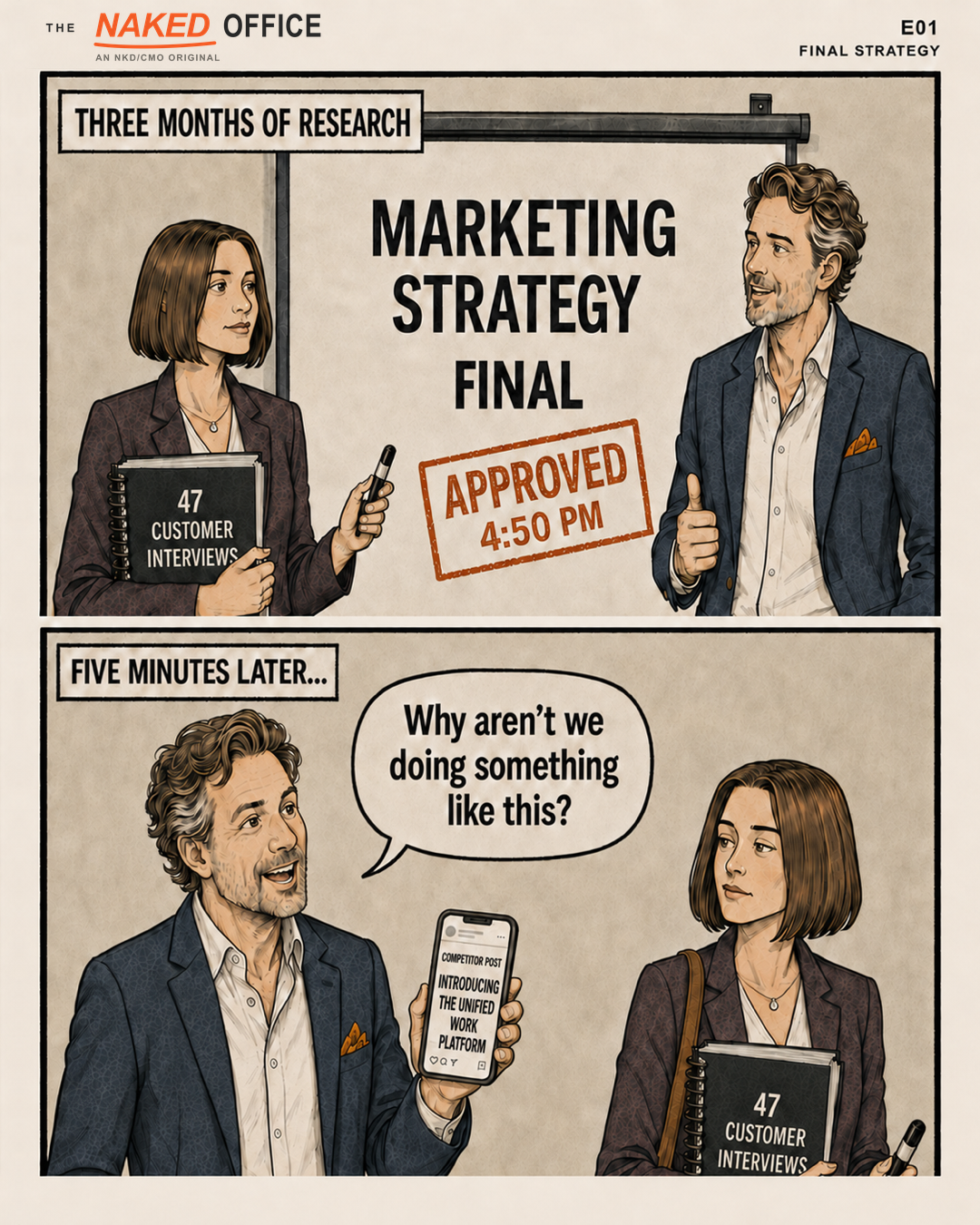
Five minutes later
At 4:50, Max approves the final strategy. At 4:55, he sees a competitor announcement and asks why Pre-Alignment Labs is not doing something similar.
Nothing inside the company changed during those five minutes. The customers did not revise their interviews. The product did not lose a capability. The market did not issue a correction. What changed was Max’s confidence in his interpretation of all three.
Max is not foolish. He is doing a job that requires him to see the future, move quickly, listen to everyone, and look calm when the future declines to cooperate.
Nina, Rachel, Tyler, and Kai can inform the decision. Investors can question it. Advisors can recommend a framework. Only Max must choose which advice to ignore. Then he has to walk back into the room and make the choice sound inevitable.
Urgency is often anxiety with executive authority.
Max has no new customer evidence. The product has not failed. The market has not moved in any measurable way. He has seen one competitor post and wondered whether somebody else understands the future better than he does.
That is a difficult thought when employees, customers, and investors expect you to see around corners. Uncertainty comes with the job. Looking uncertain does not feel as acceptable.
So Max does something. He calls a meeting and reopens the strategy. The feeling is now on the agenda. By noon, it will have a workstream.
Max had a feeling. By lunch, it had owners and a due date.
When leadership lacks conviction, the outside world gains authority.
Forty-seven customer interviews produced nuance. The competitor produced a headline. The headline wins because confidence is easier to absorb than evidence.
Competitors can reveal real shifts in customer expectations, technology, or distribution. Their activity should test a strategy. It should not write one.
A company that understands why it should win can study a competitor without becoming the competitor. A company that does not have that conviction begins borrowing direction from whoever appears most certain in public.
The competitor acquired Pre-Alignment Labs’ leadership team for five minutes. There was no charge.
A team cannot create confidence for a leader who keeps destabilizing it.
Nina did the research. Rachel brought the customer voice. Tyler supplied the numbers. Kai explained what the product could support. Max approved the result. Then Max showed everyone that approval expires whenever his confidence does.
The next time he asks for a recommendation, the team will remember what happened to the last final recommendation. Nina will preserve more options. Tyler will add more scenarios. Rachel will choose customer evidence that matches the current mood. Kai will build flexibility for a decision nobody expects to survive.
Nobody needs to lie. They only need to protect their work from the next reversal. Smart people adapt quickly to the real decision system, which is whatever the leader repeatedly does.
The strategy was final. The team misunderstood “final” as a comment about the strategy.
Take this back to work
Make the new evidence visible.
Before reopening an approved strategy, require three sentences:
- What new evidence did we receive?
- Which previous assumption does it change?
- What is the cost of changing direction now?
If the team cannot answer all three, the meeting may still be necessary. Just name it accurately. You are managing uncertainty, not revising strategy.
The naked truth
The CEO does not always trust the best evidence. Sometimes the CEO trusts the evidence that makes them feel like the CEO again.
Uncertainty comes with leadership. The damage begins when everyone else has to experience it as a change in direction.