
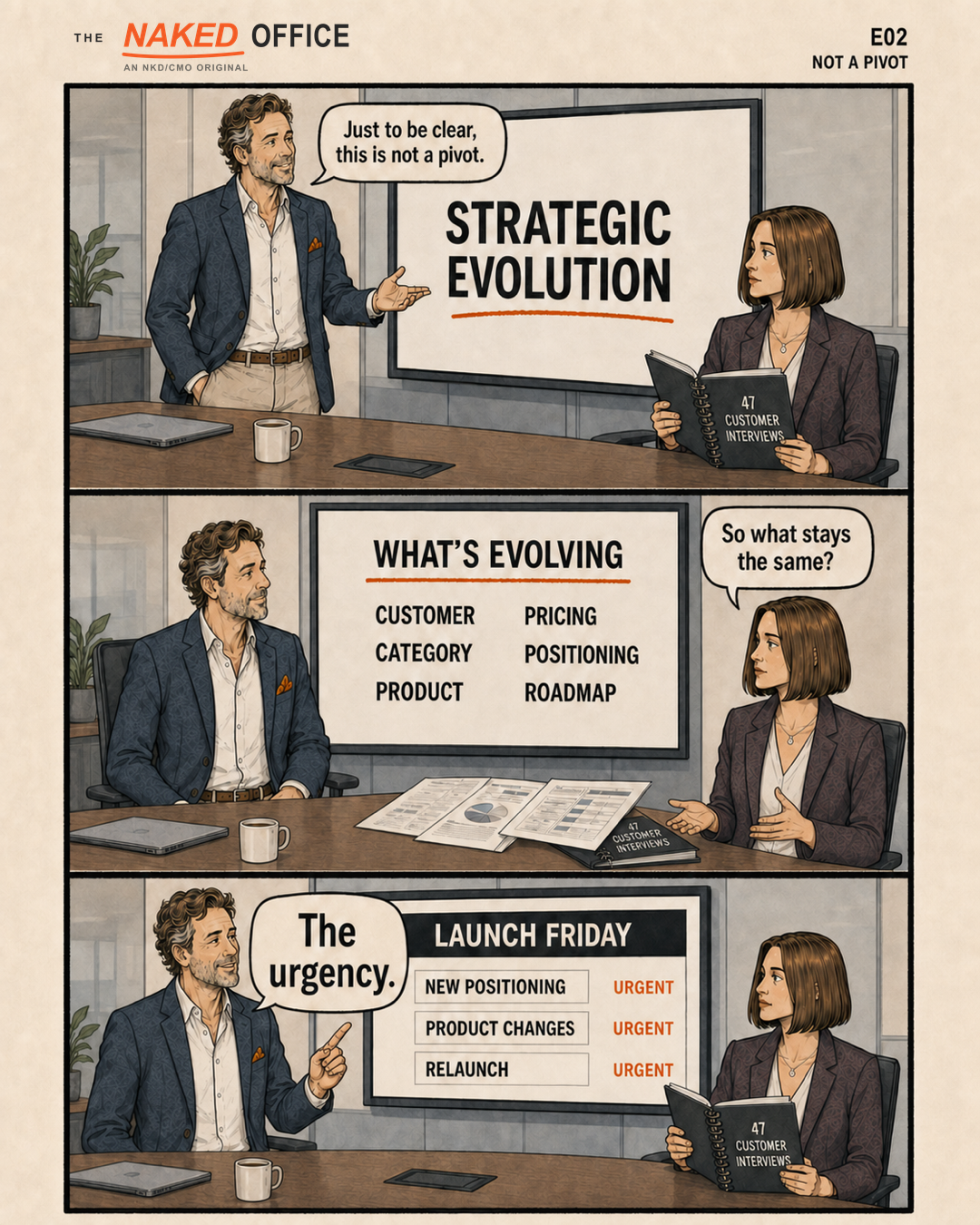
Strategic evolution
The customer is changing. The category is changing. The product, pricing, positioning, and roadmap are changing.
This is not a pivot. It is a strategic evolution, which is apparently a pivot that has retained legal counsel.
Nina asks the only operationally useful question: what stays the same? Max answers without hesitation. The urgency.
More precisely, Friday stays the same. Friday is carrying a great deal of responsibility for a day of the week. It must reassure employees that Pre-Alignment Labs is still fast and investors that leadership is still decisive. Max may appreciate the reassurance, too.
The label makes the change sound smaller. The deadline makes Max sound confident. Neither one changes the amount of work waiting for Nina when the meeting ends.
Renaming the change protects the leader, not the company.
The word “pivot” carries an uncomfortable implication: we believed one thing, learned something, and are now making a materially different bet. That should be a healthy entrepreneurial act. Learning is supposed to change decisions.
But strategic change can also feel like a judgment on the people who championed the original direction. The more publicly a leader supported that direction, the more expensive it becomes to describe the new one honestly.
“Strategic evolution” gives Max a useful compromise. He can leave most of the strategy behind while keeping the story that he saw the change coming.
Nothing failed. It evolved into something that no longer resembles the original idea.
The person who names the change controls which consequences are discussable.
“Strategic evolution” sounds like harmless executive vocabulary. Once Max names it, everyone else has to discuss it as one.
Once Max calls it an evolution, Nina cannot call it a pivot without appearing negative, inflexible, or insufficiently strategic. Her operational question is quietly recast as an attitude problem.
Nobody has to silence Nina. The language handles that. The conversation moves from “How large is this change?” to “Are you supportive of the evolution?” Soon, repeating the phrase sounds like agreement with the plan. The meeting moves on.
The pivot became much easier once everyone agreed not to call it one.
When scope changes but the deadline does not, the cost moves.
Customer, category, product, pricing, positioning, and roadmap are not six edits. They are six connected systems of work.
A different customer changes the problem. That changes the product, the promise, and what sales can safely say. The list on the screen is not a set of parallel tasks. It is a chain reaction.
Max wants all of that to change while Friday remains fixed. At this point, Friday is doing less scheduling than reassuring.
Everything changed except Friday, because Friday had executive sponsorship.
Take this back to work
Create a change ledger.
Before approving an evolution, pivot, refresh, reset, realignment, or other professionally named surprise, answer five questions:
- What are we stopping?
- What are we starting?
- Which previous assumptions are no longer valid?
- What must move: scope, resources, quality, or date?
- Who is authorized to say that the label understates the work?
If nothing is stopping and the date is not moving, the company has not created a new strategy. It has created overtime.
The naked truth
A pivot is not defined by what leadership calls it. It is defined by how much of the company must now do something different.
Honest language does not create the disruption. It gives the team a fair chance to plan for the disruption already in the room.