
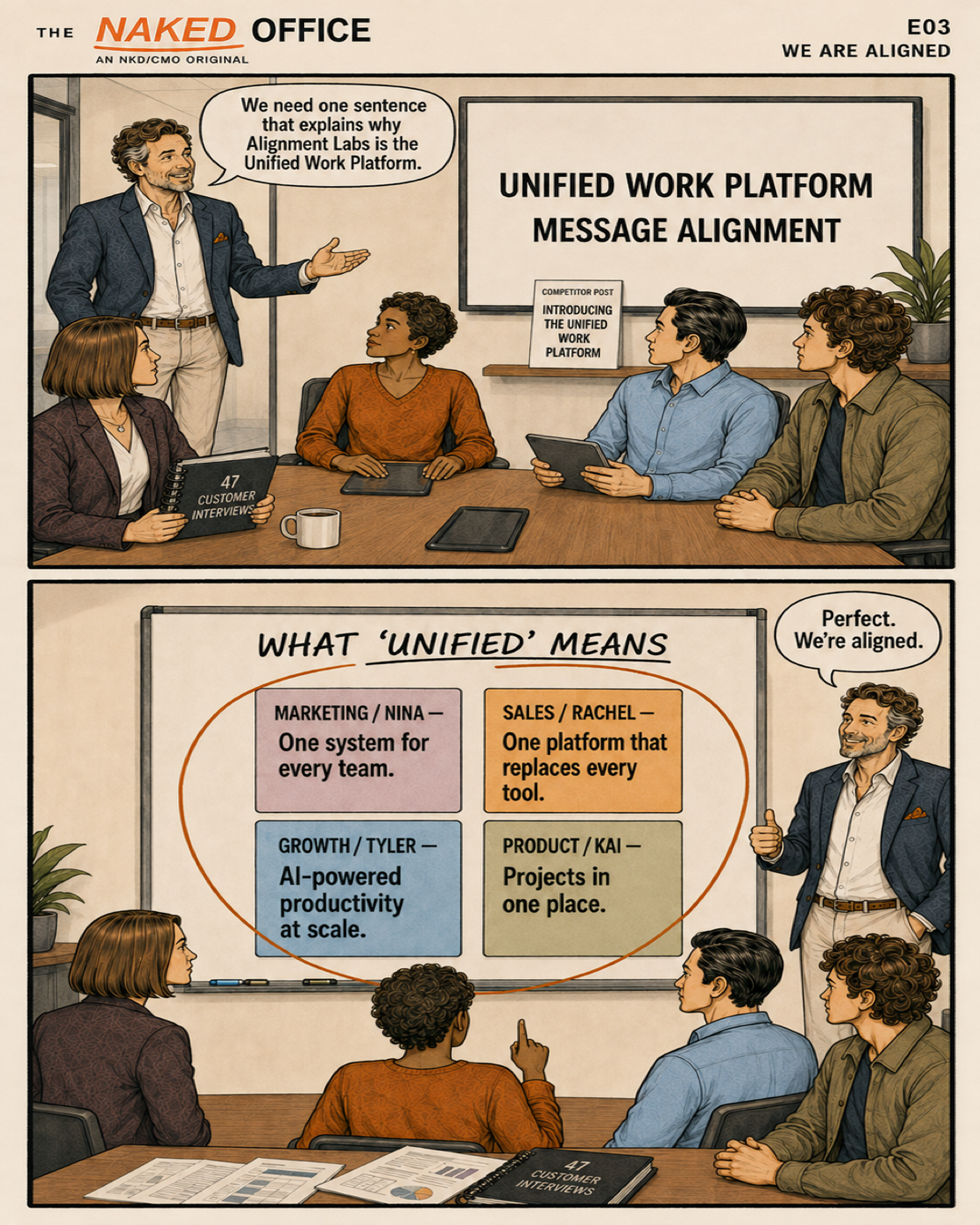
Perfect. We’re aligned.
Max needs one sentence explaining why Pre-Alignment Labs is the Unified Work Platform. The team gives him four.
Nina, Rachel, Tyler, and Kai all agree that “unified” is the right word. They also agree that it means whatever their own department needs it to mean.
Nobody is being deceptive. Each person is listening through a different responsibility. Nina hears a market position. Rachel hears a customer promise. Tyler hears a growth claim. Kai hears a product requirement.
Max sees the shared word and declares victory. The room gets the pleasant feeling of agreement without the less pleasant work of making a decision.
A shared word is not a shared decision.
“Unified” sounds specific because everyone recognizes the word. It gives nobody enough information to decide what to do.
Nina hears one system for every team. Rachel hears one platform that replaces every tool. Tyler hears AI-powered productivity at scale. Kai hears projects in one place. They are not debating four versions of the same idea. They are describing four different products.
The misunderstanding survives because the word is familiar, positive, and conveniently difficult to oppose. Nobody wants to be the person arguing against unity. So everyone accepts the word and quietly supplies the meaning they already preferred.
“Unified” is spacious enough for every department to bring its own strategy.
Ambiguity makes agreement cheaper by postponing disagreement.
The meeting feels productive because nobody has to lose. Nina keeps her enterprise story. Rachel keeps the broad product promise. Tyler keeps the AI narrative. Kai keeps the buildable version. Max gets four people nodding at one sentence.
That is the attraction of strategic ambiguity. A broad phrase can hold a coalition together when exact language would force a choice. Sometimes that flexibility is useful. Early ideas need room to develop.
The trouble begins when a phrase crosses from exploration into execution. The company starts assigning budgets, building features, writing campaigns, and making promises while the central decision is still hiding inside the vocabulary.
The meeting achieved alignment by moving the disagreement somewhere without chairs.
When meaning has no owner, the failure belongs to everyone else.
False alignment is difficult to detect because every department can execute competently. Nina can produce a strong campaign for her interpretation. Rachel can sell hers. Tyler can measure his. Kai can build his.
The problem appears between the functions. The campaign attracts customers the product was not built for. Sales promises consolidation that implementation cannot deliver. The dashboard measures activity connected to a different idea of value.
When the results arrive, each team has evidence that its part worked. The company still loses, but responsibility is distributed so evenly that nobody can locate it.
Four departments execute flawlessly. The customer receives all four companies.
Take this back to work
Run the Monday test.
Before declaring alignment, ask every function to answer the same five questions separately. Compare the answers before the meeting ends.
- Who is the customer?
- What are we promising them?
- What will we do differently on Monday?
- What are we choosing not to do?
- Who owns the shared result?
Matching vocabulary is optional. Matching decisions are not. If the answers conflict, the team has found the real meeting.
The naked truth
Alignment starts after the sentence, when everyone makes compatible decisions once the meeting is over.
If the strategy becomes less consistent as it moves through the company, execution is simply where the disagreement becomes visible.